



Understanding Dual Diagnosis Treatment in Houston
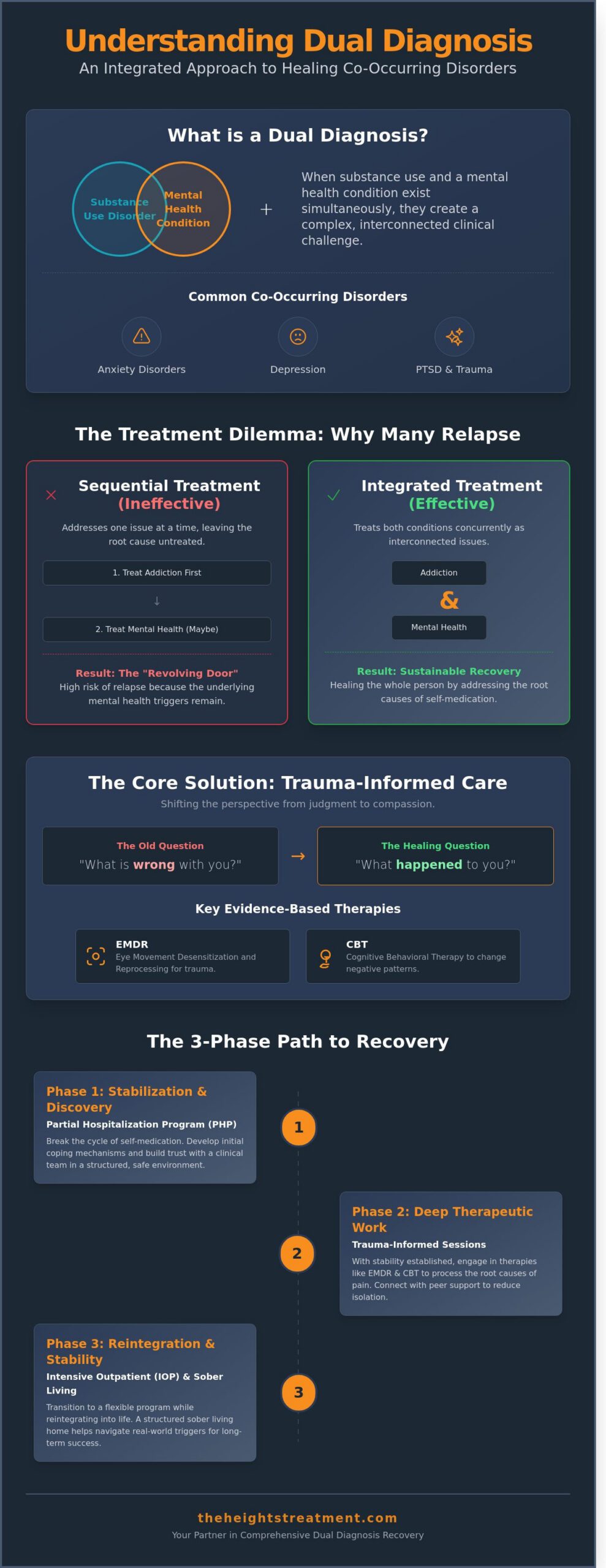
When substance use and mental health conditions exist simultaneously, it creates a complex clinical picture known as a dual diagnosis. For countless families across Houston, the struggle is compounded by co-occurring disorders that often go undiagnosed, leaving them to wonder why previous recovery attempts have failed. The core challenge lies in the treatment approach. A "sequential" model, which addresses addiction first and mental health second (or not at all), often fails. True, sustainable healing requires "integrated" care that treats both conditions concurrently as interconnected parts of a whole person. Among the most common pairings we see are substance use co-occurring with anxiety, PTSD, and depression, each feeding the other in a destructive cycle. Understanding these dual diagnosis symptoms is the first step toward finding a comprehensive solution.
The Reality of Co-Occurring Disorders in Texas
The constant pressures of life in the sprawling Houston metro area can create significant stress, leading many to self-medicate with substances to cope with underlying emotional pain. Unfortunately, many traditional Texas rehabs are structured to address only the visible addiction, often missing the foundational psychiatric component that drives the behavior. This is why a comprehensive clinical assessment upon entry is not just a formality—it is the most critical step in designing a treatment plan that has a real chance of success. Without it, the root cause of the addiction remains untreated.
Why Treating Only the Addiction Leads to Relapse
The "revolving door" of addiction treatment is a painful reality for many. Individuals enter a standard detox center, achieve short-term abstinence, and are discharged, only to relapse weeks or months later. This happens because the underlying engine of the addiction—untreated depression, bipolar disorder, or anxiety—is still running. These conditions can trigger overwhelming emotional states that reactivate the craving cycle, making relapse feel almost inevitable. Dual diagnosis is a symbiotic relationship between mind and habit; to heal one, you must heal the other.
The Role of Trauma-Informed Care in Dual Diagnosis
In many cases of dual diagnosis, trauma is the frequent "root" of both the addiction and the mental health condition. But "trauma-informed" is more than a clinical buzzword; in a Houston setting, it represents a fundamental shift in perspective. It’s the difference between asking, "What is wrong with you?" and compassionately inquiring, "What happened to you?" This approach acknowledges that self-destructive behaviors are often survival mechanisms developed in response to overwhelming experiences. At The Heights Treatment, our approach is grounded in understanding the neurobiology of trauma and teaching clients effective, healthy strategies for emotional regulation.
Evidence-Based Modalities for Complex Healing
To address the deep-seated impact of trauma, we utilize powerful, evidence-based therapies. Modalities like Eye Movement Desensitization and Reprocessing (EMDR) and Cognitive Behavioral Therapy (CBT) have a proven impact on clients with co-occurring PTSD and substance use disorders. This therapeutic work is supported by careful medication management, which can stabilize brain chemistry and create the mental space needed for breakthroughs to occur. Crucially, none of this is possible without a safe, non-judgmental environment where individuals feel secure enough to explore their most painful memories.
Individualized Intensive Programs
A "one size fits all" program is destined to fail patients with a dual diagnosis because each person’s experience is unique. Effective treatment requires a plan tailored to the specific psychiatric and substance use needs of the individual. This level of personalization extends beyond the client to their support system. We incorporate family therapy to help heal the generational trauma that is often discovered during the recovery process, creating a healthier environment for everyone involved and strengthening the foundation for lasting change. When you are ready to explore your options, our guide to choosing a trauma treatment center in Houston can provide valuable insights.
Case Study: Navigating the Path to Dual Diagnosis Recovery
To illustrate the journey, consider "Michael," a composite of many Houston professionals we’ve helped. Michael was a high-functioning executive struggling with a growing dependence on alcohol, which he used to quiet the noise of undiagnosed, crippling anxiety. From the outside, he was successful; on the inside, he was in deep emotional distress. His journey began with an intervention that helped him transition from a state of crisis into a structured Partial Hospitalization Program (PHP). It was here, through individualized intensive therapy, that the breakthrough occurred: he identified the childhood trauma that linked his anxiety to his drinking. The outcome was not just sobriety, but sustained recovery built on a foundation of clinical support and a stable sober living environment.
Phase 1: Stabilization and Discovery
The first 30 days in a Houston PHP are critical for establishing stability. The primary goal is to break the cycle of self-medication by forming a strong clinical partnership. In this phase, Michael learned to trust his therapeutic team and began developing initial coping mechanisms to manage his acute anxiety without turning to alcohol. This period provided the safety and structure needed to calm the chaos and prepare for deeper work.
Phase 2: Deep Therapeutic Work
With a foundation of stability, the focus shifted to addressing the "why" behind the "what." Michael engaged in trauma-informed sessions that allowed him to process the root causes of his pain. Simultaneously, he connected with the vibrant Houston recovery community, where peer support validated his experiences and reduced his sense of isolation. He began integrating tools for managing his dual diagnosis symptoms into his daily life, building resilience and self-awareness.
Phase 3: Reintegration and Long-Term Stability
As Michael gained confidence and skills, he transitioned from the immersive PHP to a more flexible Intensive Outpatient Program (IOP), allowing him to maintain his clinical ties while slowly reintegrating into his professional and personal life. His move into a structured sober living home was instrumental in helping him navigate Houston-based triggers without relapsing. The final result was not just abstinence but a life of comprehensive healing, where he felt equipped to manage both his mental health and his sobriety for the long term.
Choosing the Right Dual Diagnosis Rehab in Houston
Selecting the right program is a crucial decision. The most effective facilities are defined by a few key characteristics.
- Look for multidisciplinary teams that include psychiatrists, licensed therapists, and recovery advocates who collaborate on your care.
- Prioritize facilities that offer a full continuum of care, including both a Partial Hospitalization Program (PHP) and an Intensive Outpatient Program (IOP) to support you through different phases of recovery.
- Ensure the program has dedicated trauma-informed modalities as a core part of its clinical philosophy, not just an add-on.
- Evaluate the quality and structure of any associated sober living environments, as this is a key component of long-term success.
What to Ask a Houston Treatment Provider
When you speak with a potential provider, don’t hesitate to ask direct questions to gauge their expertise and approach.
- How do you coordinate care between the psychiatrist managing medication and the primary therapist conducting sessions?
- Is your clinical staff specifically trained and certified in trauma-informed care modalities like EMDR?
- What is the plan for long-term support, alumni services, and community connection after the intensive phase ends?
The Importance of Location and Environment
Where you receive treatment matters. Staying in Houston for treatment allows you to build a local support network that will be there for you long after you complete the program. An outpatient setting also provides the flexibility to maintain vital connections with family and work, making recovery feel more integrated with real life. Finally, seek out a facility that avoids a sterile, hospital-like feel. A warm, human-centric environment fosters a sense of safety and dignity, which is essential for deep healing.
The Heights Treatment: Leading Dual Diagnosis Care in Houston
Our philosophy is simple: we are committed to treating the whole person—mind, body, and spirit. From our welcoming facility in The Heights neighborhood, we serve the Greater Houston community by providing a central hub for sophisticated clinical care. We believe in the powerful synergy between our intensive outpatient programs and our supportive sober housing, creating a complete ecosystem for recovery. Our private-pay model allows us to focus entirely on the needs of our clients, ensuring the highest standard of individualized care without outside interference.
A Compassionate Guide to Your New Beginning
We operate from a philosophy of empowerment and personal growth. Our goal is to help you move beyond the limiting label of "addict" and discover the heights of your true potential. We believe that recovery is not about shame or punishment, but about courage, self-discovery, and profound transformation. Taking the first step can be daunting, but our compassionate team is here to guide you through the process, starting with a comprehensive clinical assessment.
The Community Connection
Lasting recovery is not built in isolation. It is forged in community. We help you build a lasting recovery network right here in the heart of Texas, connecting you with peers, mentors, and resources that will support you for years to come. Our active alumni and family sessions play a vital role in long-term success, ensuring that the healing extends beyond our walls and into your daily life.
Begin your journey to comprehensive healing today
FAQs About Dual Diagnosis Treatment
What exactly is a dual diagnosis and how is it treated in Houston?
A dual diagnosis, or co-occurring disorder, is when a person experiences a mental health disorder and a substance use disorder simultaneously. In Houston, the most effective treatment is an integrated approach that addresses both conditions at the same time through a combination of psychotherapy, medication management, and supportive care, rather than treating them separately.
Can I attend dual diagnosis rehab while still living at home in Houston?
Yes. Programs like Partial Hospitalization (PHP) and Intensive Outpatient (IOP) are designed to provide a high level of clinical care while allowing you to live at home or in a supportive sober living environment. This helps you integrate recovery skills into your daily life in real time.
How long does a typical dual diagnosis program at The Heights Treatment last?
The length of treatment is highly individualized and depends on your specific clinical needs. Programs can range from 30 days to several months. We focus on reaching clinical milestones rather than adhering to a rigid timeline to ensure you are fully prepared for long-term success.
What happens if I have a mental health crisis during addiction treatment?
Our multidisciplinary team, including on-site therapists and psychiatric professionals, is equipped to manage mental health crises. An integrated program means your mental health is continuously monitored, and your treatment plan can be adjusted immediately to provide the necessary support and stabilization.
Do I need to go to detox before starting a dual diagnosis program in Houston?
While The Heights Treatment does not provide medical detoxification services, a stable physical state is necessary to engage in deep therapeutic work. We can refer you to trusted detox partners in the Houston area and will coordinate with them to ensure a seamless transition into our program once you are medically cleared.
What is the difference between a PHP and an IOP for dual diagnosis?
A Partial Hospitalization Program (PHP) is more intensive, typically involving treatment for several hours a day, five days a week. An Intensive Outpatient Program (IOP) is a step-down level of care with fewer hours per week. PHP is ideal for initial stabilization, while IOP is designed to support the transition back to daily life while maintaining strong clinical support.
How does trauma-informed therapy help with addiction recovery?
Trauma-informed therapy recognizes that addiction is often a coping mechanism for unresolved trauma. By creating a safe environment and using modalities like EMDR, it helps individuals process the root causes of their pain. This approach reduces the emotional triggers that lead to substance use, making long-term recovery more sustainable.