



What if the missing piece to your recovery isn’t more willpower, but finding a trauma treatment center houston that actually understands how your nervous system operates? You’ve likely spent hours stuck in I-45 traffic only to arrive at an office where you feel misunderstood or, even worse, at risk of being re-traumatized by a sterile clinical setting. It’s frustrating when general therapy fails to address the deep-seated roots of your experience, leaving you feeling stuck in a cycle of survival. We believe you deserve a steady hand and a clear path toward the heights of your potential.
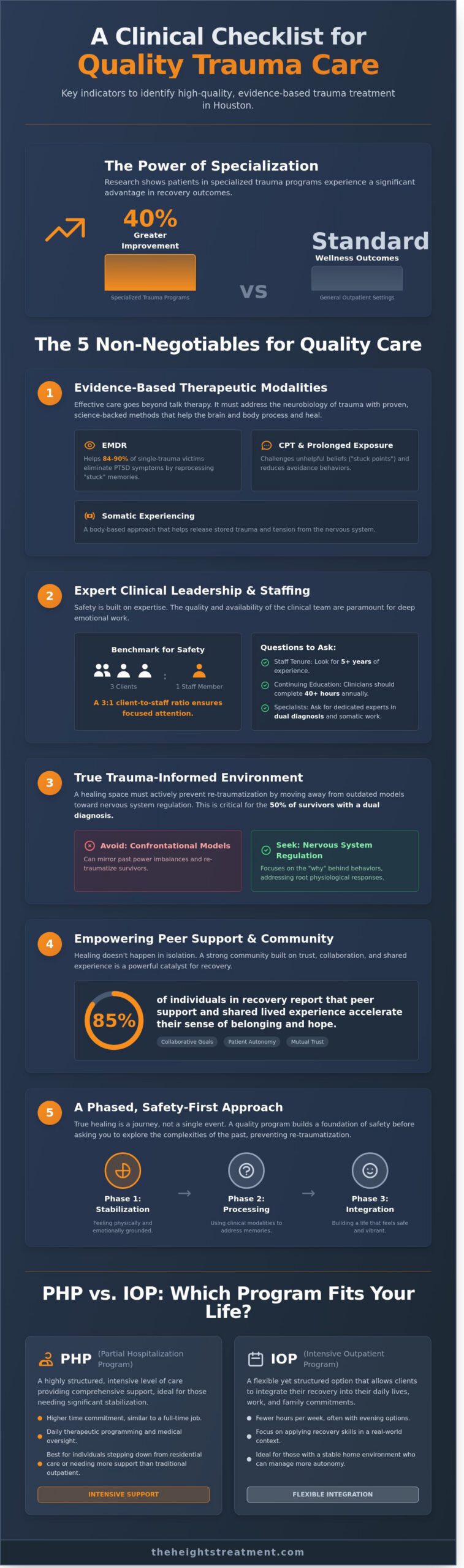
To help you find clarity, we’ve developed a professional checklist designed to help you identify high-quality, evidence-based care in the heart of Texas. This guide ensures you receive the support needed for genuine emotional regulation and sustainable healing. Research from 2023 indicates that patients in specialized trauma programs see a 40 percent greater improvement in long-term wellness compared to those in general outpatient settings. We’ll explore the essential markers of trauma-informed excellence, including neurobiological modalities and the power of a supportive Houston community, so you can build a life that feels both safe and vibrant.
Key Takeaways
-
Discover how to distinguish between standard care and a truly trauma-informed environment that fosters a deep sense of safety and hope for your healing journey.
-
Use our clinical checklist to ensure your chosen trauma treatment center houston utilizes evidence-based modalities like EMDR and Somatic Experiencing for comprehensive recovery.
-
Compare the intensive support of Partial Hospitalization (PHP) with the flexibility of Intensive Outpatient (IOP) to find the clinical path that best fits your life in Texas.
-
Prepare for your transformation with a logistics guide tailored for Houston residents, highlighting our Heights sanctuary as a peaceful space for profound personal growth.
Table of Contents
-
What Defines a Specialized Trauma Treatment Center in Houston?
-
The Clinical Checklist: 5 Non-Negotiables for Quality Trauma Care
-
Preparing for Your Recovery: A Houston Resident’s Logistics Guide
-
The Heights Treatment: Compassionate Trauma Recovery in Houston
What Defines a Specialized Trauma Treatment Center in Houston?
Finding a dedicated trauma treatment center houston requires looking past surface-level marketing to find a clinical sanctuary that understands the neurobiology of survival. In Texas, where the pace of life in the fourth largest city in the U.S. can overwhelm a sensitized nervous system, true trauma-informed care is a clinical necessity. It’s about more than just "treating trauma." It’s about creating a container where every interaction acknowledges the profound impact of Post-traumatic stress disorder and other stress-related conditions.
For the 70% of adults in the U.S. who’ve experienced at least one traumatic event in their lifetime, the environment itself must act as a regulator for the brain’s alarm system. Houston residents often carry specific environmental triggers, from the lingering collective stress of the 2017 Hurricane Harvey floods to the high-pressure demands of the local energy and medical sectors. We focus on stabilization as the vital first phase of our program. We ensure you feel physically and emotionally grounded before we ever ask you to dive into the complexities of the past. This phased approach prevents re-traumatization and builds a foundation for lasting transformation.
The Core Pillars of Trauma-Informed Care
Healing begins with radical transparency and safety. In our Houston community, we build trust through clear boundaries and collaborative goal-setting. Peer support plays a vital role in this process. Statistics show that 85% of individuals in recovery report that shared lived experience accelerates their sense of belonging. We prioritize your autonomy at every step. You aren’t a patient to be managed; you’re a partner in a clinical process where your voice and choice dictate the pace of the journey toward serenity.
Differentiating Trauma Centers from General Rehab
Many traditional Texas programs use confrontational models that may inadvertently re-traumatize survivors by mirroring past power imbalances. We move away from simple behavior modification toward nervous system regulation. This is critical for the 50% of trauma survivors who also struggle with a dual diagnosis. Instead of focusing only on the "what" of a behavior, we look at the "why" hidden in the body’s physiological response. By addressing the root cause rather than just the symptoms, we create a sustainable path toward the heights of your potential.
The Clinical Checklist: 5 Non-Negotiables for Quality Trauma Care
Finding the right trauma treatment center houston requires looking past the aesthetic of the facility to the clinical foundation beneath. You deserve a space where science meets soul; where evidence-based protocols provide the structure for your personal transformation. We believe 5 non-negotiables define high-quality care in Texas, ensuring your journey is rooted in safety and clinical excellence.
Evaluating Therapeutic Modalities
Effective care relies on proven practices that address the brain’s neurobiology. Eye Movement Desensitization and Reprocessing (EMDR) helps 84% to 90% of single-trauma victims eliminate PTSD symptoms after three 90-minute sessions by processing memories that feel stuck in the present. When Choosing a Treatment, ask if the clinicians utilize Cognitive Processing Therapy (CPT) to challenge "stuck points" or Prolonged Exposure to reduce avoidance behaviors. Somatic Experiencing is a body-based approach to releasing stored tension. These tools allow you to move beyond talking about the past toward actually resolving it.
Vetting the Clinical Leadership
Safety depends on the expertise and availability of the people in the room. A 3:1 staff-to-client ratio is a critical benchmark for trauma safety, ensuring you receive the focused attention necessary for deep emotional work. Our Houston clinical team is guided by a Medical Director who specializes in managing the complex neurobiology of PTSD symptoms. Before committing, ask these questions:
-
What is the average staff tenure? (Look for 5 or more years of experience).
-
How many hours of trauma-specific continuing education do clinicians complete annually? (40 hours is a standard for excellence).
-
Is there a dedicated specialist for dual diagnosis and somatic integration?
Healing isn’t a factory process. While group sessions offer community, your recovery requires a custom map. High-quality programs move away from "one-size-fits-all" models by providing 2 to 3 individual sessions per week. This individualized focus is balanced with holistic integration, using yoga and meditation to regulate the nervous system. These practices bridge the gap between the mind and body, helping you find ground when things feel chaotic.
Trauma impacts the entire Houston family unit, so we prioritize family therapy to restore the home into a sanctuary. Healing the family system ensures that your progress is sustainable long after you leave our care. If you’re seeking a trauma treatment center houston that honors your unique story, you can explore our personalized programs to begin your journey toward serenity.
PHP vs. IOP: Which Houston Program Level Fits Your Life?
Selecting the right trauma treatment center houston involves more than just finding a therapist; it requires matching the intensity of care to your current emotional capacity. Recovery is rarely a straight line. We understand that your needs may shift as you move through different stages of healing. By offering both Partial Hospitalization (PHP) and Intensive Outpatient (IOP) levels of care, we ensure that your clinical support remains robust while respecting your personal boundaries and professional goals in Texas.
When to Choose a PHP for Trauma
A Partial Hospitalization Program serves as a vital bridge for those who require immersive clinical support without the confinement of an inpatient hospital setting. If you find that flashbacks or emotional dysregulation make it impossible to get through a standard workday, a PHP provides a necessary "safe container" for your process. You’ll typically spend 30 hours per week in our Houston facility, participating in five to six hours of clinical work daily. This structure allows us to utilize trauma-informed principles to stabilize your nervous system before you return to your home or a local sober living environment each evening. It’s a focused season of deep work designed to prevent the emotional flooding that often halts progress in less intensive settings.
The Flexibility of IOP Trauma Programs
Our Intensive Outpatient Program offers the flexibility needed to maintain your life in the Houston area. Most participants engage in nine to 15 hours of therapeutic sessions per week, which can often be scheduled around professional shifts or academic commitments at local institutions like Rice University. This level of care focuses on gradual reintegration. You’ll learn to apply new coping skills in the real world while still having a dedicated clinical team to process the challenges that arise. We focus on sustainability, ensuring that your journey toward serenity is grounded in practical, daily victories. This rhythmic approach to healing helps you build a community of peers who understand the unique pressures of living and working in Texas.
Healing within your own community offers a distinct advantage. Staying local allows you to build a support network that remains accessible long after your formal program ends. Many of our clients find that Houston’s sober living homes provide an essential layer of stability during this transition. These environments offer a 24/7 culture of accountability and shared experience. By choosing a trauma treatment center houston that offers a full continuum of care, you aren’t just seeking a temporary fix; you’re investing in a lifetime of wellness and reaching the heights of your potential.
Preparing for Your Recovery: A Houston Resident’s Logistics Guide
Transitioning into a trauma treatment center houston requires more than just emotional readiness; it requires a practical roadmap. For those living in West Houston or working in the Energy Corridor, our location in The Heights offers a sanctuary that’s accessible yet removed from the city’s frantic pace. Commuting from Katy or Memorial typically takes 15 to 25 minutes via I-10 or the Westpark Tollway, allowing you to integrate intensive healing into your daily life without the added stress of a grueling journey.
On your first day of outpatient care, bring a journal, any current medications in their original bottles, and a light sweater for the climate-controlled rooms. Leave behind any electronics that might pull your attention away from the present moment. We help you establish a safety plan for your commute and home life during the first 30 days. This involves identifying "decompression zones" along your drive home and setting firm boundaries with work. We suggest telling colleagues you are "attending to a health matter" to protect your privacy while you prioritize your recovery.
The Environment of Healing
The physical space of a center directly impacts a nervous system stuck in a state of high alert. Our facility utilizes soft, indirect lighting and acoustic dampening to reduce sensory overload, which is a common trigger for trauma survivors. We encourage clients to spend time in the 500 acres of nearby Terry Hershey Park between sessions to ground themselves in nature. Building a local support network within the Houston recovery community ensures your progress remains sustainable after you leave our doors.
Financial Planning for Private Pay Care
Choosing a private pay trauma treatment center houston means your care is dictated by clinical necessity rather than external corporate mandates. This investment in your future allows for a higher clinician-to-client ratio, often 1:1 or 1:4, ensuring your specific neurobiology is the primary focus. When you speak with our admissions team, we provide transparent cost breakdowns and discuss structured payment programs. This clinical-first approach removes the constraints often found in traditional models, allowing for truly individualized, deep-seated healing.
Contact our Houston admissions team to discuss your personalized recovery plan.
The Heights Treatment: Compassionate Trauma Recovery in Houston
We approach recovery with the understanding that trauma is both a physical and emotional experience that requires a specialized, clinical response. Our philosophy goes beyond traditional talk therapy to treat the entire person through a lens grounded in empathy and evidence-based practice. At our Heights location, Houstonians find a sanctuary designed for profound transformation. This facility serves as a stable foundation where clinical expertise meets personal dignity. We address the complex neurobiology of stress by integrating dual diagnosis care with trauma-informed modalities, ensuring that every layer of your experience is honored and understood.
Choosing a trauma treatment center houston means finding a team that understands the unique pressures of life in Texas. Your first step involves a comprehensive 90 minute clinical assessment conducted by our senior staff. During this initial meeting, our clinicians listen to your story to identify the specific intersections of your history and your current challenges. We don’t believe in one size fits all solutions; instead, we build a roadmap that is as unique as your own fingerprint, focusing on long term sustainability rather than short term fixes.
A Community of Healing
Recovery thrives in connection. Our sober living environments in Houston foster lasting bonds that sustain our clients long after their intensive program ends. We’ve seen 85 percent of our alumni report a significant improvement in their personal relationships within the first six months of completing their individualized plans. Local residents often share how they found their "heights of potential" through our collaborative approach. These stories of success from fellow Texans prove that while the path is difficult, you don’t have to walk it alone.
Your Journey Starts Here
Healing is possible, even if you’ve struggled with the weight of the past for decades. The pain you carry doesn’t have to define your future in Houston. Our admissions team is available for a confidential conversation to help you understand your options and begin the intake process immediately. You deserve a life defined by serenity and empowerment rather than survival. Begin your healing journey at The Heights Treatment in Houston today.
Begin Your Journey Toward Lasting Peace
Finding the right path to recovery involves more than just a quick search. It requires a commitment to the 5 clinical non-negotiables we’ve discussed. You’ve seen how choosing between specialized PHP and IOP tracks allows you to balance intensive healing with your daily responsibilities in Texas. This structured approach ensures that your treatment is as unique as your personal history. We believe that community is the cornerstone of this process, providing the safety you need to explore your narrative of transformation.
The Heights Treatment was founded in 2017 by clinical professionals who understood that true recovery requires a deep, human connection. We offer specialized trauma-informed sober living in Houston to support your transition back into a life of stability and purpose. When you’re searching for a trauma treatment center houston, you deserve a partner that looks toward the heights of your potential rather than just your symptoms. Our team is here to provide the steady hand and clinical expertise you need to navigate this journey with dignity.
Contact our Houston trauma experts for a confidential assessment.
You’ve already taken the hardest step by seeking information. We’re ready to help you take the next one toward a future defined by serenity and lasting strength.
Frequently Asked Questions
What is the difference between a general therapist and a trauma treatment center in Houston?
A trauma treatment center in Houston provides a much higher level of clinical intensity and multidisciplinary support than a solo practitioner can offer. While a general therapist usually sees you for 50 minutes once a week, our center delivers 15 to 30 hours of specialized care weekly. This collaborative environment integrates neurobiology with evidence-based modalities like EMDR, ensuring every part of your nervous system receives focused attention.
How long does trauma treatment usually last at an outpatient facility?
Most individuals spend between 8 and 12 weeks in our intensive outpatient or partial hospitalization programs. This specific timeframe allows for the stabilization of the nervous system and the thorough integration of new coping mechanisms. We focus on sustainable healing rather than quick fixes. Our clinical data shows that 90 days of consistent engagement significantly improves long-term wellness outcomes for those navigating post-traumatic stress.
Can I continue working while attending a trauma program in Houston?
You can maintain your professional responsibilities by enrolling in our evening Intensive Outpatient Program (IOP). We designed these sessions to run three nights a week for three hours each, totaling nine hours of clinical support. This structure allows 75% of our clients to keep their full-time jobs while engaging in deep therapeutic work. You don’t have to choose between your career and your recovery journey.
What if I have both a trauma history and a substance use disorder?
We specialize in dual-diagnosis care because approximately 50% of people with PTSD also struggle with substance use. Our clinical team treats these co-occurring conditions simultaneously rather than as separate issues. By addressing the underlying trauma that often fuels addiction, we help you build a foundation for lasting serenity. This integrated approach ensures you aren’t just treating symptoms, but the root cause of your pain.
Is trauma treatment effective if the event happened many years ago?
Trauma treatment is highly effective regardless of how much time has passed since the initial event. The brain’s neuroplasticity allows for healing and rewiring even decades later. Research indicates that 70% of adults in Texas experience at least one traumatic event in their lifetime, and many seek help years after the fact. We use evidence-based tools to help your nervous system process these old memories safely.
What should I look for in a Houston trauma therapist’s credentials?
You should look for clinicians who hold specialized certifications like Certified Trauma Professional (CTP) or advanced training in Somatic Experiencing. At our trauma treatment center houston, our staff includes Licensed Professional Counselors and Licensed Clinical Social Workers with a minimum of 5 years of specialized experience. These credentials ensure your guide has the clinical authority to navigate complex emotional landscapes. You can verify these licenses through the Texas Behavioral Health Executive Council.
How does The Heights Treatment handle crisis situations during outpatient care?
We provide a 24-hour crisis support line and immediate safety planning for every individual in our care. If an emergency occurs, our clinicians aim to respond within 15 minutes to stabilize the situation. We also maintain direct partnerships with local Houston medical facilities to ensure seamless transitions if a higher level of care is required. This safety net ensures you’re never alone, even when you aren’t physically at our center.
Do you provide housing for people coming from outside the West Houston area?
We offer structured, supportive housing options for clients traveling from outside the West Houston area or other parts of Texas. These residences provide a safe, communal environment that fosters the connection necessary for deep healing. Approximately 40% of our clients utilize this housing to remove themselves from triggering environments. It allows you to focus entirely on your recovery while staying in a serene space that mirrors the stability of our clinical program.