



When the weight of addiction or a mental health crisis feels overwhelming, the path forward can seem unclear. You know you need help—structured, professional, and effective—but the idea of putting your entire life on hold for residential treatment isn’t feasible. This is where a crucial level of care offers a powerful alternative: the Intensive Outpatient Program (IOP). For those searching for an "intensive outpatient program near me" in Houston, understanding how this model works is the first step toward reclaiming your life without stepping away from it completely.
Discover how a structured, trauma-informed Intensive Outpatient Program can provide the clinical support you need while maintaining your life in Houston, Texas.
What is an Intensive Outpatient Program (IOP) and How Does It Work?
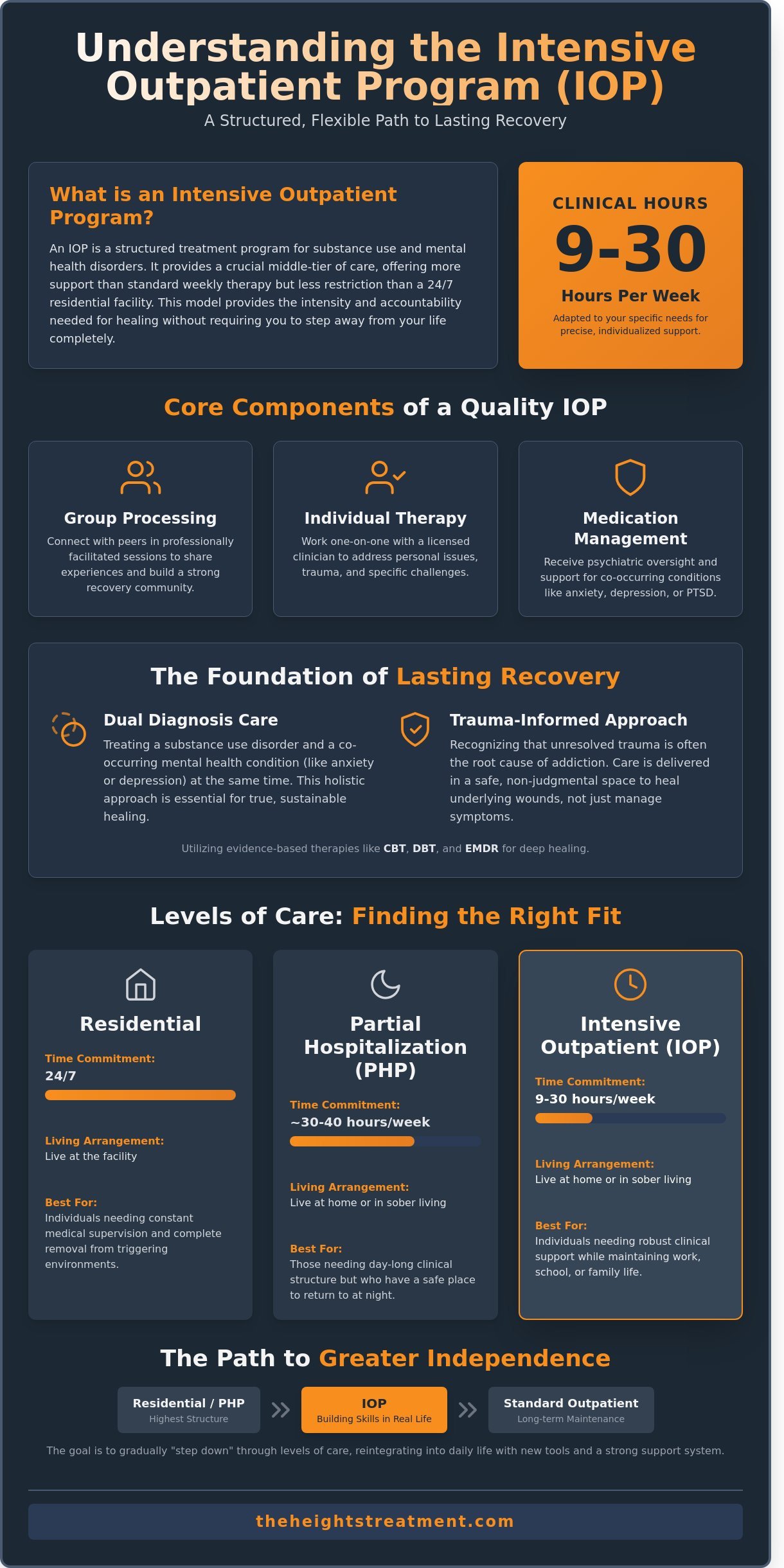
An Intensive Outpatient Program (IOP) is a structured form of treatment for substance use and mental health disorders that serves as a vital middle tier of care. It is more concentrated than standard weekly therapy but less restrictive than a residential or Partial Hospitalization Program (PHP). It occupies a crucial ‘sweet spot’ in the recovery landscape, providing intensive clinical support for 3-5 days a week while allowing you to return to your own home each evening.
This structure is designed to help you build a sustainable foundation for recovery within your natural environment. By adhering to the high standards set by the American Society of Addiction Medicine (ASAM) here in Texas, a quality IOP gives you the tools, accountability, and community needed to integrate healing into your daily life, not escape from it.
The Core Components of an IOP Schedule
A typical IOP requires a commitment of 9-30 hours per week, spread across several days. This time is thoughtfully balanced to foster both personal insight and community connection. Your schedule will include:
- Group Therapy: Processing experiences and building skills in a professionally facilitated group setting is the cornerstone of IOP. It breaks the isolation that so often accompanies addiction and mental health struggles.
- Individual Therapy: One-on-one sessions with a dedicated therapist allow you to dive deeper into your personal history, address underlying trauma, and tailor your recovery plan to your unique needs.
- Medication Management: For many, recovery is supported by psychiatric care. A clinical IOP incorporates medication management to ensure co-occurring disorders like anxiety or depression are treated effectively and safely.
Who is the Ideal Candidate for an IOP?
An IOP is a powerful tool for healing, but it’s most effective for individuals at a specific stage of their recovery journey. You may be an ideal candidate if you are:
- Transitioning from a higher level of care, such as a residential stay or a Partial Hospitalization Program (PHP), and need a structured step-down to support your reintegration.
- Living in a stable and supportive home environment but require a high degree of clinical accountability to prevent relapse and build coping skills.
- A professional in Houston who needs to maintain work commitments while dedicating significant time to healing from addiction or mental health challenges.
The Importance of Dual Diagnosis and Trauma-Informed Care in an IOP
The most common misconception about addiction is that it can be treated as a standalone issue. In reality, substance use is often a symptom of a deeper wound. To achieve lasting recovery, treatment must address not just the behavior but the underlying pain. This is why a clinically sophisticated IOP is built on the pillars of dual diagnosis and trauma-informed care.
- Dual Diagnosis: This clinical term simply means treating a substance use disorder and a co-occurring mental health condition—like anxiety, depression, or PTSD—at the same time. One cannot be healed without addressing the other.
- Trauma-Informed Care: This is the bedrock of preventing chronic relapse. It’s an approach that recognizes the pervasive impact of trauma and creates a safe, non-judgmental environment where healing can begin.
- Clinical Modalities: To facilitate this healing, effective IOPs utilize evidence-based therapies such as Cognitive Behavioral Therapy (CBT), Dialectical Behavior Therapy (DBT), and Eye Movement Desensitization and Reprocessing (EMDR).
Healing the Underlying Wound: Trauma-Informed Therapy
Trauma, whether from a single event or a long-term environment, fundamentally changes the neurobiology of the brain, making it more susceptible to addiction. A trauma-informed approach is not about forcing you to relive painful memories; it’s about creating a "safety-first" environment where you feel seen, heard, and respected. In this non-judgmental space, clinicians guide you in understanding how past experiences influence present behaviors, empowering you to break the cycle.
Managing Co-Occurring Disorders for Long-Term Stability
True stability is achieved when psychiatric support and addiction counseling work in synergy. An individualized treatment plan in a dual-diagnosis IOP adapts to your specific mental health needs, ensuring that medication, therapy, and skill-building are all aligned. This comprehensive approach often includes family therapy, a critical component that helps heal the entire domestic system, creating a network of support that is essential for long-term wellness.
IOP vs. PHP vs. Residential: Which Level of Care Do You Need?
Choosing the right level of care is critical for a successful outcome. Each program is designed for a different level of clinical need, and understanding the distinctions can help you and your family make an informed decision.
| Level of Care | Time Commitment | Living Arrangement | Clinical Intensity |
|---|---|---|---|
| Residential Treatment | 24/7 for 30-90+ days | On-site at the facility | Highest level of supervision |
| Partial Hospitalization (PHP) | 5-7 days/week, 6-8 hours/day | Live at home or in sober living | High, with daily medical/clinical access |
| Intensive Outpatient (IOP) | 3-5 days/week, 3-5 hours/day | Live at home or in sober living | Moderate, focused on integration |
| Standard Outpatient | 1-2 hours per week | Live at home | Low, for maintenance and support |
The concept of "stepping down" through these levels is a hallmark of quality treatment, as it allows you to gradually take on more independence while still being supported by a clinical safety net. For many, IOP offers the perfect balance of intensive care and real-world flexibility, making it a more cost-effective option than 24/7 residential facilities.
When to Choose PHP Over IOP
If you or a loved one requires a higher degree of medical or clinical supervision, a Partial Hospitalization Program may be the appropriate starting point. PHP provides a level of structure and support that is second only to residential care. The standard of excellence in recovery often involves a thoughtful transition from PHP in Houston to an IOP, ensuring a seamless and supportive continuum of care.
The Limitations of Standard Outpatient Therapy
While weekly therapy is an invaluable tool for maintaining mental wellness, one hour a week is often insufficient for someone in early recovery. Attempting to manage a complex dual diagnosis with minimal support can lead to under-treating the condition, increasing the risk of relapse. An IOP provides the necessary clinical "immersion" to build a strong foundation without requiring the total isolation of a residential program.
Navigating IOP Options in Houston, Texas
When you search for an "intensive outpatient program near me," the results can be overwhelming. In a city as large as Houston, it’s essential to look beyond the marketing and focus on the markers of a high-quality, effective program. The local recovery landscape is robust, but not all centers are created equal.
Your search should prioritize local accreditation from bodies like the Joint Commission or CARF, which signals a commitment to the highest standards of clinical care. Because you’ll be commuting to treatment, practical factors like location and accessibility are also key. A program located conveniently to your home or work makes it easier to stay consistent and committed.
The Role of Sober Living in Houston’s Recovery Community
Houston has become a hub for structured, high-quality sober living communities, and for good reason. Integrating your IOP treatment with a stay in a supportive sober living home can dramatically increase your chances of long-term success. Living among peers who are on the same journey provides a built-in support system, 24/7 accountability, and a safe, substance-free environment to practice the skills you learn in therapy. At The Heights Treatment, we seamlessly integrate our clinical care with premier sober living in Houston to provide a comprehensive healing experience.
What to Look for in a Local Treatment Center
As you evaluate your options in Houston, ask these critical questions:
- Cost Verification: Do they work with your insurance provider? Are they cast-pay? What financial resources do they provide? What are the differences between in-network and out-of-network services/facilities?
- Clinical Staff: Is the program run by licensed clinical professionals (LPCs, LCSWs, PhDs) rather than just support staff or "techs"?
- Community Integration: Is the center located near and connected to local support groups like AA, NA, or SMART Recovery meetings?
The Heights Treatment: Elevating Your Recovery Journey
At The Heights Treatment, we believe that recovery is not a clinical checklist; it is a journey of elevation. We’ve created an Individualized Intensive Program that stands as the gold standard for outpatient care in Houston. Our approach is defined by a rare combination of deep clinical expertise and a compassionate, human-first philosophy. We are not just here to treat you; we are here to walk beside you as wise guides on your path to healing.
Why Our Individualized Approach Works
We move beyond the "cookie-cutter" model of therapy to design a treatment plan that honors your specific life story, challenges, and goals. Our program masterfully integrates holistic wellness practices with evidence-based clinical science, treating the whole person—mind, body, and spirit. Our Houston facility provides a serene, welcoming sanctuary for transformation, a place where you can feel safe enough to do the deep work of healing.
Taking the First Step Toward Your Potential
Reaching out for help is the bravest step you can take. When you call our admissions team, you will be met with compassion and understanding, not judgment. We will walk you through a confidential assessment and help you find a path forward that fits your life.
Begin Your Personalized Recovery Journey at The Heights Treatment
Joint Commission Accredited
Dual Diagnosis Specialists
Trauma-Informed Clinical Team
Serving the Greater Houston Area and Texas
Frequently Asked Questions
How much does an intensive outpatient program (IOP) cost in Texas?
The cost of an IOP in Texas varies widely based on the provider, the length of the program, and your insurance coverage. Our admissions team can provide a complimentary benefits check to give you a clear understanding of your financial responsibility.
Can I continue working or going to school while in an IOP?
Yes. One of the primary benefits of an IOP is its flexibility. Programs are typically offered in the morning or evening, allowing you to maintain your professional, academic, and family commitments while receiving intensive treatment.
How long does a typical IOP program last?
The duration of an IOP is based on individual clinical needs, but most programs last between 8 to 12 weeks. The goal is to ensure you have built a strong enough foundation to confidently transition to a lower level of care, like standard outpatient therapy.
What is the difference between IOP and "rehab"?
"Rehab" is a general term often used to describe residential treatment, where a person lives at the facility 24/7. An IOP is a specific level of outpatient care where you attend treatment for several hours a day, several days a week, but continue to live at home.
Do I need to go to detox before starting an IOP near me?
For individuals with a physical dependence on substances like alcohol or benzodiazepines, a medically supervised detox is almost always required before starting an IOP. Detox ensures you are medically stable and able to fully engage in the therapeutic process. An IOP is not a substitute for detox.
What happens if I relapse while in an intensive outpatient program?
Relapse is sometimes a part of the recovery process and is not viewed as a failure. If a relapse occurs, your clinical team will work with you to understand what happened, adjust your treatment plan, and determine if a temporary step-up to a higher level of care is needed to ensure your safety and stability.
Is family therapy included in the IOP at The Heights Treatment?
Absolutely. We believe that addiction and mental health conditions impact the entire family system. Family therapy and education are integral components of our IOP, helping to heal relationships, improve communication, and build a strong support network for your long-term recovery.